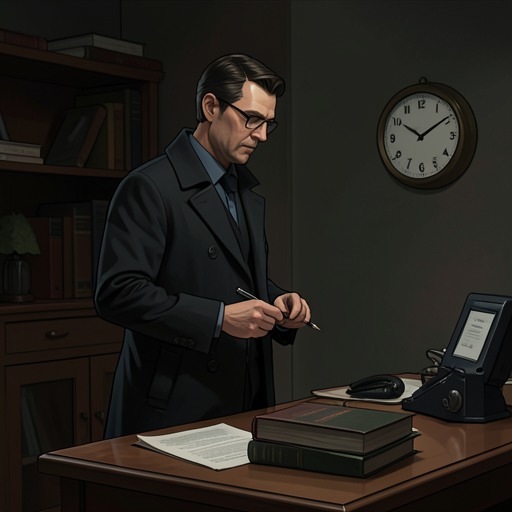
George Stark’s decay and recovery
The Dark HalfGeorge Stark’s decay and recovery are the bodily expression of his dependence on Thad Beaumont and the unstable division between them. Stark’s deterioration marks the danger of losing his ability to write; when Thad helps him write again, the change reverses, and Stark’s healing is matched by fresh signs of damage to Thad. The apparent recovery therefore does not resolve their conflict: it makes their connection visible as a transfer of strength and threatens to shift the decay from one body to the other.
The Body as a Measure of Survival
Before the writing resumes, Liz fears that the collaboration may succeed in ways that cannot be contained. She imagines that if Thad gives Stark the needed start and Stark can write on his own, his wounds may heal—and that Stark might begin to take over Thad’s face and form. In the same imagined aftermath, Liz fears that sores will appear on Thad, followed by a decline Stark will not prevent. Her fears frame the possibility of recovery as a change in who bears the cost, not as a simple cure.
That threat rests on the story’s insistence that only one physical being can claim the dual natures of Thad Beaumont and George Stark. Their divided identity is not merely an idea: it places the survival of one in tension with the survival of the other. Liz’s apprehension gives the bodily changes a forward-looking consequence. If Stark recovers, Thad may be the one who begins to deteriorate.
Writing Reverses the Decline
The turning point comes during the pair’s renewed work on the story of Alexis Machine. After Stark reads over what he has written, Thad agrees that it makes sense. As Thad touches the corner of his mouth, he notices that a new sore has appeared there; at the same moment, a similar sore has disappeared from Stark’s mouth. The paired change supplies immediate evidence that their bodies are responding in opposite directions.
Stark’s improvement continues while he is absorbed in the violent world of Alexis Machine. The sores recede, damaged skin begins to regain its healthy appearance, and the signs of infection described in the scene diminish. The change is not presented as independent of the writing: Stark is healing while he works, making renewed creative activity the occasion for his physical restoration.
The Teeter-Totter Between Thad and Stark
Thad’s body registers the other end of Stark’s recovery. A sore begins to rise on Thad’s temple, while the small white scar left by the operation performed in the year his real life began disappears. The contrast ties Stark’s present healing to a visible alteration in Thad, linking their unequal physical conditions to their shared history without making the exchange a straightforward return to health.
Thad understands the pattern as a teeter-totter: when one end rises, the other has to fall. The principle gives the scene its governing image and clarifies why Stark’s better appearance is ominous as well as encouraging. Recovery for Stark is not evidence that the danger has passed; it is the counterpart of change in Thad, whose new sore and vanishing scar place him on the declining side of the balance.
Significance and Unresolved Outcome
The changes establish a connection between writing and physical survival. Stark’s ability to enter the fictional world of Alexis Machine coincides with the mending of his body, while Thad experiences the corresponding signs of deterioration. In this way, the story makes authorship more than a contest of will: continuing the work appears to help sustain Stark, but the benefit carries a bodily cost for the man whose creative capacity made Stark possible.
The passage leaves that exchange unresolved. Thad notes that the time is approaching when he will have to act, but the visible improvement in Stark does not settle which of them can survive the division. Instead, the restored skin, Thad’s new sore, and the vanished surgical scar sharpen the central danger: Stark’s apparent return to health may be the beginning of Thad’s decline, and their collaboration may make the struggle between their identities harder, not easier, to end.